Henry VIII ruled England from 1509 to 1547 and was famous for overfondness for eating and bumping off wives. It's often forgotten that he was a capable military leader who turned the British navy into something that would be respected the world over for the next 500 years.
As a man of military interests, he collected a large variety of weapons and armor. Many of them are now in the Royal Armouries, including these two strange weapons.
The first is a what's called a Holy Water Sprinkler, basically a heavy spiked club. This one has an extra feature, though. Included in the head are three short pistols. You can see the touch hole for one of them in this photo.
Another example is this metal buckler with a pistol. Firearms were just coming into their own at this time, developing from the medieval handgonne to superior matchlock and wheellock weapons. The shield is richly engraved and like the Holy Water Sprinkler doesn't appear to ever have been used. In fact, there's no record of these combination weapons ever being issued to troops. They do look cool, though, and are tempting to add to a story sometime!
Pages
Fantasy, mystery, thrillers, horror, historical. . .I write it all, and review it too!
Showing posts with label warfare. Show all posts
May 20, 2013
Mar 18, 2013
Estonian armor from the early Middle Ages
Travel writer and novelist Sean McLachlan sent in this interesting photo from his recent trip to Estonia. Sean writes:
"I spotted this reconstructed armor in Kiek in de Kök tower in the capital Tallinn. The city is one of the best-preserved medieval old towns in Europe, and this tower is now a museum. Before the medieval city, there was a hillfort at nearby Iru hill from the 6-11th century. Among the many finds from the excavation was this armor.
"It's what's called scale armor, an improvement on leather armor that added metal scales for extra protection. At this period, plate armor didn't exist, and even in more technologically advanced regions like France soldiers wore leather or chain mail."
Sean is the author of the Civil War novel A Fine Likeness, available in paperback and ebook. The ebook is only $2.99 at the moment.
Do you have any interesting photos to share of medieval or Renaissance subjects? Drop me a line!
"I spotted this reconstructed armor in Kiek in de Kök tower in the capital Tallinn. The city is one of the best-preserved medieval old towns in Europe, and this tower is now a museum. Before the medieval city, there was a hillfort at nearby Iru hill from the 6-11th century. Among the many finds from the excavation was this armor.
"It's what's called scale armor, an improvement on leather armor that added metal scales for extra protection. At this period, plate armor didn't exist, and even in more technologically advanced regions like France soldiers wore leather or chain mail."
Sean is the author of the Civil War novel A Fine Likeness, available in paperback and ebook. The ebook is only $2.99 at the moment.
Do you have any interesting photos to share of medieval or Renaissance subjects? Drop me a line!
Jan 22, 2013
Did the Battle of Hastings really happen where we're told it did?
The Battle of Hastings is perhaps the most famous fight in medieval history. When King Harold died with an arrow through the eye (the most popular theory, there are others) and William got his new nickname "the Conqueror" on that day in 1066, the history of England and Western Europe changed.
For centuries we've been told that the battle happened on Senlac Hill near the town of Hastings. Indeed, Battle Abbey, commissioned by WIlliam himself, stands atop it.
But now some historians doubt that story, and they have two different candidates for the battle site. One suggests that the battle happened a mile north on Caldbec Hill, while the other says it happened two miles south of town at Crowhurst.
The Caldbec Hill site is the most intriguing. It's a steeper hill than the gently sloping Senlac Hill, and contemporary accounts said the hill atop which Harold and his Saxons stood was as steep one. On the other hand, a thousand years of weathering could have mellowed out Senlac hill. More telling is the fact that no weapons or bones have ever been found on Senlac Hill and that it was cultivated at the time, while accounts of the battle said it happened on unploughed land.
Also, the Normans erected a cairn of stones called a "Mount-joie" on the battlefield to celebrate their victory. The summit of Caldbec Hill is still known as Mountjoy. There's also the account of John of Worcester who that the battle was fought nine miles from Hastings, the same distance as Caldbec Hill.
The Crowhurst site is supported by a historian who has made a close study of medieval documents and looked at the landscape shown on the Bayeaux Tapestry and said that Crowhurst is the best candidate.
The Battlefields Trust, which manages the site, says in a press release says that they still think the traditional place is the correct one. They stated there's insufficient evidence for the Crowhurst site to be considered, and that they're still analyzing the argument for Caldbec Hill.
I'll have more on this as this story develops. Stay tuned!
Top photo by Antonio Borillo. Bottom photo from Wikipedia.
For centuries we've been told that the battle happened on Senlac Hill near the town of Hastings. Indeed, Battle Abbey, commissioned by WIlliam himself, stands atop it.
But now some historians doubt that story, and they have two different candidates for the battle site. One suggests that the battle happened a mile north on Caldbec Hill, while the other says it happened two miles south of town at Crowhurst.
The Caldbec Hill site is the most intriguing. It's a steeper hill than the gently sloping Senlac Hill, and contemporary accounts said the hill atop which Harold and his Saxons stood was as steep one. On the other hand, a thousand years of weathering could have mellowed out Senlac hill. More telling is the fact that no weapons or bones have ever been found on Senlac Hill and that it was cultivated at the time, while accounts of the battle said it happened on unploughed land.
Also, the Normans erected a cairn of stones called a "Mount-joie" on the battlefield to celebrate their victory. The summit of Caldbec Hill is still known as Mountjoy. There's also the account of John of Worcester who that the battle was fought nine miles from Hastings, the same distance as Caldbec Hill.
The Crowhurst site is supported by a historian who has made a close study of medieval documents and looked at the landscape shown on the Bayeaux Tapestry and said that Crowhurst is the best candidate.
The Battlefields Trust, which manages the site, says in a press release says that they still think the traditional place is the correct one. They stated there's insufficient evidence for the Crowhurst site to be considered, and that they're still analyzing the argument for Caldbec Hill.
I'll have more on this as this story develops. Stay tuned!
Top photo by Antonio Borillo. Bottom photo from Wikipedia.
Nov 26, 2012
Medieval Mondays: The Iron Arm of Götz von Berlich
| "I will crush you." |
![]() |
| "The peasants are revolting, and I'm revolting too!" |
Luckily, craftsmen in this period were skilled at making prosthetics for just such occasions. They made him an iron limb that could open and close it fingers, so it could still be used in battle. He became known at Götz of the Iron Hand. His hand was so well made it could even hold a pen. Perhaps he used it when he wrote his memoirs.
Just goes to show that the late Medieval/early Renaissance period was more sophisticated than we generally believe.
Images courtesy Wikipedia.
Nov 19, 2012
Medieval Mondays: Visiting Ukhaidher Castle, Iraq
Today, our sometimes guest blogger Sean McLachlan returns with an amazing story. He just got back from 17 days in Iraq. That's right, he actually visited Iraq as a tourist. Follow the link to read his fascinating series. Today he's talking to us about exploring an early medieval castle in the desert.
About 50 km (30 miles) southwest of Karbala, there's a mystery standing in the middle of the desert. It's called Ukhaidher ("small green place") Castle and is said to have been built in the 8th century, right at the beginning of the Abbasid dynasty. An oasis stands nearby, hence the name.
Beyond that, little is known about Ukhaidher Castle. Some believe it actually dates from before the Islamic era, to the time of a Christian Arab named Ukhaidher who was expelled from Arabia in 635 AD. Others say it was a Muslim hunting lodge, or a retirement palace for an aged prince.
Whether it has its origins in the pre-Islamic era or not, it was certainly used by the Abbasids and it certainly is impressive. Its walls stand 21 meters (69 ft.) high.
A very early mosque on the site created controversy when it was excavated. The miqrab, or niche that is supposed to face Mecca, appears to face Jerusalem instead. This isn't the only such mosque from the early days of Islam not to face Mecca. The Iraqi archaeologist who discovered this had his funding cancelled and never got to publish his findings. Unfortunately when I visited I didn't have a compass with me, so I can't say for sure where it points. I did get to climb the partially ruined minaret and take some shots from a good vantage point.
Like many archaeological sites, it was heavily restored during Saddam Hussein's rule, more with an eye for grandeur than historical accuracy. The castle was in good enough condition, however, that this particular reconstruction is better than most.
Readers into all things medieval might want to check out my post on exploring medieval Baghdad.
Thanks for having me, A.J.! Besides blogging for Gadling, I run Civil War Horror, dedicated to dark fiction, the American Civil War, and the Wild West. Guest bloggers are always welcome. I'm the author of numerous books including A Fine Likeness, a historical novel set in Civil War Missouri, and The Night the Nazis Came to Dinner, a collection of dark speculative fiction. The electronic editions are both on sale at the moment. You can also check me out on Twitter, Facebook, Goodreads, and my Amazon author's page.
All photos copyright Sean McLachlan.
About 50 km (30 miles) southwest of Karbala, there's a mystery standing in the middle of the desert. It's called Ukhaidher ("small green place") Castle and is said to have been built in the 8th century, right at the beginning of the Abbasid dynasty. An oasis stands nearby, hence the name.
Beyond that, little is known about Ukhaidher Castle. Some believe it actually dates from before the Islamic era, to the time of a Christian Arab named Ukhaidher who was expelled from Arabia in 635 AD. Others say it was a Muslim hunting lodge, or a retirement palace for an aged prince.
Whether it has its origins in the pre-Islamic era or not, it was certainly used by the Abbasids and it certainly is impressive. Its walls stand 21 meters (69 ft.) high.
A very early mosque on the site created controversy when it was excavated. The miqrab, or niche that is supposed to face Mecca, appears to face Jerusalem instead. This isn't the only such mosque from the early days of Islam not to face Mecca. The Iraqi archaeologist who discovered this had his funding cancelled and never got to publish his findings. Unfortunately when I visited I didn't have a compass with me, so I can't say for sure where it points. I did get to climb the partially ruined minaret and take some shots from a good vantage point.
Like many archaeological sites, it was heavily restored during Saddam Hussein's rule, more with an eye for grandeur than historical accuracy. The castle was in good enough condition, however, that this particular reconstruction is better than most.
Readers into all things medieval might want to check out my post on exploring medieval Baghdad.
Thanks for having me, A.J.! Besides blogging for Gadling, I run Civil War Horror, dedicated to dark fiction, the American Civil War, and the Wild West. Guest bloggers are always welcome. I'm the author of numerous books including A Fine Likeness, a historical novel set in Civil War Missouri, and The Night the Nazis Came to Dinner, a collection of dark speculative fiction. The electronic editions are both on sale at the moment. You can also check me out on Twitter, Facebook, Goodreads, and my Amazon author's page.
All photos copyright Sean McLachlan.
Nov 12, 2012
Medieval Mondays: Armor wasn't as cumbersome as commonly thought
One of the common misconceptions about medieval armor was that it was incredibly cumbersome. An oft-repeated tale was that knights had to use a crane to get themselves onto their horses. This seems to come from Henry VIII, who at his fattest could barely move himself, let alone a load of armor.
As this video briefly and clearly shows, armor had a lot more movement than generally thought.
In The Face of Battle, John Keegan points out that the load for the average infantryman stayed the same for much of history. The Tommies going "over the top" in World War One carried just as much weight as an armed and armored medieval knight. Both of these warriors could climb, get up from a prone position, and manage a lumbering run.
The real problem for knights was heat exhaustion. With the faceplate down and most of the body covered, medieval knights often passed out from their exertions. This was an especially serious issue when fighting the Crusades in the Middle East.
For more detailed coverage, check out this lecture by Dirk H. Breiding, Assistant Curator, Department of Arms and Armor, The Metropolitan Museum of Art.
Oct 1, 2012
Aleppo souk, one end of the Silk Road, destroyed in Syrian revolution
I was very sad to read today in the Irish Times that the medieval souk in Aleppo, Syria, was destroyed in the fighting between the dictatorship and antigovernment forces.
Called Al-Madina (the City), it was a cluster of covered markets connected to one another and built around the 13th century. Located close to the Mediterranean, Aleppo acted as the western end of the Silk Road. Think of all the cultures that must have mingled in these arched hallways and little shops! Hopefully the stonework has survived and they'll be able to rebuild this historic gathering place and UNESCO World Heritage Site.
The top photo comes from some guy calling himself farflungistan. The other one was taken by Zaid El-Hoiydi, who has a really cool website of photos about Syria.
Called Al-Madina (the City), it was a cluster of covered markets connected to one another and built around the 13th century. Located close to the Mediterranean, Aleppo acted as the western end of the Silk Road. Think of all the cultures that must have mingled in these arched hallways and little shops! Hopefully the stonework has survived and they'll be able to rebuild this historic gathering place and UNESCO World Heritage Site.
The top photo comes from some guy calling himself farflungistan. The other one was taken by Zaid El-Hoiydi, who has a really cool website of photos about Syria.
Sep 18, 2012
Irish castle for sale: a bit of a fixer-upper but a bargain at €75,000
If you're like me, you've always dreamed of living in your own castle. Well, if you happen to have €75,000 ($97,850) you can! It's called Ballyfinboy Castle and it's an easy commute from Limerick, Ireland.
The castle was built around 1480. The first record of the castle was when it was captured in 1599. The owner, Phillip Kennedy, and men were all put to the sword and the castle was broken up enough that it could never be used again.
That's where YOU come in. Sure, it needs some work, but wouldn't it make a nice home? You even get two-and-a-half acres of land and a nice Sheela-na-gig, locally known as "the Dancer", positioned high up one of the walls. Hit the link to find out more about these interesting carvings. The castle is for sale from Premier Properties Ireland. You can see more photos on their website and also here.
The castle was built around 1480. The first record of the castle was when it was captured in 1599. The owner, Phillip Kennedy, and men were all put to the sword and the castle was broken up enough that it could never be used again.
That's where YOU come in. Sure, it needs some work, but wouldn't it make a nice home? You even get two-and-a-half acres of land and a nice Sheela-na-gig, locally known as "the Dancer", positioned high up one of the walls. Hit the link to find out more about these interesting carvings. The castle is for sale from Premier Properties Ireland. You can see more photos on their website and also here.
Aug 13, 2012
Medieval Mondays: Qasr Kharana castle, Jordan
I was blanking on what to write about for this week's Medieval Mondays post until I saw this photo as the image of the day on Wikimedia Commons. It shows the desert castle of Qasr Kharana in Jordan.
This is one of the oldest Arab castles in the Middle East, having been built around 710, according to an inscription in one of the rooms. As any student of the Middle Ages knows, the Crusaders were impressed by Middle Eastern castles and were inspired to make thier own in Europe. There had been castles in Europe before the Crusades of course, but most were crude forts like the Motte and Bailey castles.
Qasr Kharana may be better called a fortified place rather than a castle. Some say it may have been a caravanserai or the stronghold of a local ruler. Nobody knows for sure.
The plan is simple: a square 115 feet to a side with a series of small round projecting towers. Some sixty rooms in two stories look onto an interior courtyard. This layout is similar to the typical caravanserai but Qasr Kharana isn't on any known early medieval trade route. On the other hand, many wealthy homes also had this layout.
Some researchers suggest that Qasr Kharana was only inhabited on a temporary basis. They point to the small cistern and the absence of a bath (de rigueur for wealhty medieval Arabs) as proof that it wasn't inhabited year-round. It may have been a governor's temporary abode while meeting with and collecting tribute from the Bedouin.
This is one of the oldest Arab castles in the Middle East, having been built around 710, according to an inscription in one of the rooms. As any student of the Middle Ages knows, the Crusaders were impressed by Middle Eastern castles and were inspired to make thier own in Europe. There had been castles in Europe before the Crusades of course, but most were crude forts like the Motte and Bailey castles.
Qasr Kharana may be better called a fortified place rather than a castle. Some say it may have been a caravanserai or the stronghold of a local ruler. Nobody knows for sure.
The plan is simple: a square 115 feet to a side with a series of small round projecting towers. Some sixty rooms in two stories look onto an interior courtyard. This layout is similar to the typical caravanserai but Qasr Kharana isn't on any known early medieval trade route. On the other hand, many wealthy homes also had this layout.
Some researchers suggest that Qasr Kharana was only inhabited on a temporary basis. They point to the small cistern and the absence of a bath (de rigueur for wealhty medieval Arabs) as proof that it wasn't inhabited year-round. It may have been a governor's temporary abode while meeting with and collecting tribute from the Bedouin.
Jun 25, 2012
Medieval Mondays: Female rebels in the Middle Ages
Last week I talked about Hussite war wagons, which a couple of readers pointed out were essentially medieval tanks. Another curious aspect of the Hussite peasant army was that many of the fighters were women.
This is a cover shot of some Hussite figures distributed by Kingmaker Miniatures. It shows burly peasant women wielding flails. Normally used for threshing grain, they were just as effective at threshing skulls. Records show that women were involved in all aspects of the rebellion, although they were generally left out of pictorial depictions.
A recent BBC article also talks about the role of women in the 1381 Peasant's Revolt. It turns out some of the main leaders were women. This was not mentioned or downplayed by contemporary chroniclers and thus the fact was missed by later scholars. Now new studies of the trials of captured rebels show that a good number were women. Check out the link to learn more.
Women had a strong role in medieval peasant society and were treated by men as near equals in many areas. This was not the case between middle- and upper-class men and women.
This is a cover shot of some Hussite figures distributed by Kingmaker Miniatures. It shows burly peasant women wielding flails. Normally used for threshing grain, they were just as effective at threshing skulls. Records show that women were involved in all aspects of the rebellion, although they were generally left out of pictorial depictions.
A recent BBC article also talks about the role of women in the 1381 Peasant's Revolt. It turns out some of the main leaders were women. This was not mentioned or downplayed by contemporary chroniclers and thus the fact was missed by later scholars. Now new studies of the trials of captured rebels show that a good number were women. Check out the link to learn more.
Women had a strong role in medieval peasant society and were treated by men as near equals in many areas. This was not the case between middle- and upper-class men and women.
Jun 18, 2012
Medieval Mondays: Hussite War Wagons
Warriors in the Middle Ages thought up all sorts of strange weapons. One of the strangest was the war wagon, developed during the Hussite Wars in Bohemia from 1419-1436.
The war started when Jan Hus led a protest movement against the sale of indulgences and other corrupt practices by the Catholic Church. He was assassinated in 1415 while attending negotiations with the Church, and his supporters rose up in revolt against the ruling Holy Roman Empire and the Church itself. They called themselves Hussites after their slain leader and rallied around Jan Zizka, a one-eyed knight. The religious revolt soon took up the banner of Czech independence.
Zizka knew the peasants wouldn’t stand a chance against knights, so he converted farm wagons into mobile forts by covering them with wooden planks and chaining them together. These wagons could be drawn into a square or circle called a wagenburg.
Each wagon was protected by wooden siding equipped with loopholes. They were crewed by handgonners, crossbowmen, and peasants armed with flails and halberds. The crossbowmen and handgonners fired from the loopholes while those with melee weapons protected the gaps between the wagons while themselves being protected by men holding large shields called pavises.
As you can see, most of the wagenburg equipment could be found or easily made in any peasant village. Flails were everyday items, and any blacksmith could make a halberd or simply adapt a farm implement and put it on the end of a pole. He could also make the simple handgonnes of the time.
The peasants could maintain devastating volleys or a continuous fire. The wagons even carried a supply of rocks so those not armed with a ranged weapon could toss the rocks while their comrades reloaded. Other wagons had cannons mounted on them. The enemy would attack and the heavy fire from the wagons would disorganize their ranks. Then part of the wagenburg would open up and the Hussites would counter-attack.
Enemy knights fell for this tactic again and again, convinced they could easily beat the “peasant rabble”. Eventually they began to learn and defeated some Hussite armies by luring them out of their protection with fake retreats or destroying wagons with artillery. Other armies began to adopt the wagenburg but newer, more mobile artillery eventually made the tactic obsolete.
For more on the Hussite Wars and early black powder weapons, see my friend and fellow blogger Sean McLachlan's book; Medieval Handgonnes: The First Black Powder Infantry Weapons.
Photos from Wikimedia Commons.
The war started when Jan Hus led a protest movement against the sale of indulgences and other corrupt practices by the Catholic Church. He was assassinated in 1415 while attending negotiations with the Church, and his supporters rose up in revolt against the ruling Holy Roman Empire and the Church itself. They called themselves Hussites after their slain leader and rallied around Jan Zizka, a one-eyed knight. The religious revolt soon took up the banner of Czech independence.
Zizka knew the peasants wouldn’t stand a chance against knights, so he converted farm wagons into mobile forts by covering them with wooden planks and chaining them together. These wagons could be drawn into a square or circle called a wagenburg.
Each wagon was protected by wooden siding equipped with loopholes. They were crewed by handgonners, crossbowmen, and peasants armed with flails and halberds. The crossbowmen and handgonners fired from the loopholes while those with melee weapons protected the gaps between the wagons while themselves being protected by men holding large shields called pavises.
As you can see, most of the wagenburg equipment could be found or easily made in any peasant village. Flails were everyday items, and any blacksmith could make a halberd or simply adapt a farm implement and put it on the end of a pole. He could also make the simple handgonnes of the time.
The peasants could maintain devastating volleys or a continuous fire. The wagons even carried a supply of rocks so those not armed with a ranged weapon could toss the rocks while their comrades reloaded. Other wagons had cannons mounted on them. The enemy would attack and the heavy fire from the wagons would disorganize their ranks. Then part of the wagenburg would open up and the Hussites would counter-attack.
Enemy knights fell for this tactic again and again, convinced they could easily beat the “peasant rabble”. Eventually they began to learn and defeated some Hussite armies by luring them out of their protection with fake retreats or destroying wagons with artillery. Other armies began to adopt the wagenburg but newer, more mobile artillery eventually made the tactic obsolete.
For more on the Hussite Wars and early black powder weapons, see my friend and fellow blogger Sean McLachlan's book; Medieval Handgonnes: The First Black Powder Infantry Weapons.
Photos from Wikimedia Commons.
Mar 26, 2012
Medieval Mondays: Mass grave from the Battle of Lützen being excavated
Archaeologists are excavating a mass grave from the Battle of Lützen, a 1632 battle in Germany that was a turning point in the Thirty Years War.
The team has found an estimated 75 skeletons, all male and apparently stripped since no artifacts or traces of clothing have been found. The bones will be analyzed to find cause of death, health, and age. Isotope analysis will determine where they originated from. At the moment it is unknown which army the grave represents.
The Battle of Lützen was fought between the Protestant army of Sweden under the famous general Gustavus Adolphus and the Catholic army of the Holy Roman Empire. It was unusual in several ways, the first being that it was fought in November, when most Renaissance armies preferred to be in winter quarters.
It was also unusual in that the Protestants won the battle and lost in the long term. After a hard fight they broke the Catholic army, which fled in partial disorder. Gustavus Adolphus, however, was cut down by Catholic cavalry and with his genius for leadership and strategy gone, the Protestant cause lost much of the wind from its sails. Sweden lost its prime place in the Protestant coalition, although the war ended in the Protestants' favor.
The team has found an estimated 75 skeletons, all male and apparently stripped since no artifacts or traces of clothing have been found. The bones will be analyzed to find cause of death, health, and age. Isotope analysis will determine where they originated from. At the moment it is unknown which army the grave represents.
The Battle of Lützen was fought between the Protestant army of Sweden under the famous general Gustavus Adolphus and the Catholic army of the Holy Roman Empire. It was unusual in several ways, the first being that it was fought in November, when most Renaissance armies preferred to be in winter quarters.
It was also unusual in that the Protestants won the battle and lost in the long term. After a hard fight they broke the Catholic army, which fled in partial disorder. Gustavus Adolphus, however, was cut down by Catholic cavalry and with his genius for leadership and strategy gone, the Protestant cause lost much of the wind from its sails. Sweden lost its prime place in the Protestant coalition, although the war ended in the Protestants' favor.
Feb 6, 2012
Medieval Mondays: Reconstructions of Motte-and-Bailey castles
I've always been fond of motte-and-bailey castles. Perhaps that's because I've always been fascinated with the origins of things, like the world's oldest condom. Familiar to any student of the Middle Ages, these rough and ready fortifications provided a cheap and quick way to defend your territory.
For those who aren't as obsessed with castles as I am, a motte-and-bailey castle is an artificial mound (motte) with a keep and wall on top, and a lower enclosed area (bailey) surrounded by a wall. Both parts are surrounded by a ditch, the soil of which was used to make the Motte. An artist's rendering of one can been seen in the above photo courtesy Duncan Grey.
These castles had the advantage of being able to be built by unskilled labor in a matter of months or even weeks, as opposed to stone castles that required highly skilled artisans working for years. The most famous are those of the Normans, who needed lots of quick castles as they expanded through the British Isles.
Trolling through the Interwebs the other day I discovered that in at least two places there are reconstructions of motte-and-bailey castles. The one pictured above is Saint Sylvain d'Anjou dans le Maine et Loire, France. The photo is courtesy Wikipedia. The bottom one is from Turmhügelburg in Nienthal von Lütjenburg, northern Germany, and is also courtesy Wikipedia.
As you can see, neither has a very high motte. This was common, although we tend to think of them having very tall mottes, perhaps because the taller examples have survived better and were often maintained and had stone keeps built atop them at later periods. Windsor castle in England is the most famous example.
While they don't look like much, you must remember that the heyday for these castles was the late 10th through early 12th centuries AD. Siege technology was at a low ebb in Northern Europe, armies were small, and feudal levies wouldn't hang around long enough to commit to an extended siege. Thus the humble motte-and-bailey castle was a formidable defense.
For those who aren't as obsessed with castles as I am, a motte-and-bailey castle is an artificial mound (motte) with a keep and wall on top, and a lower enclosed area (bailey) surrounded by a wall. Both parts are surrounded by a ditch, the soil of which was used to make the Motte. An artist's rendering of one can been seen in the above photo courtesy Duncan Grey.
These castles had the advantage of being able to be built by unskilled labor in a matter of months or even weeks, as opposed to stone castles that required highly skilled artisans working for years. The most famous are those of the Normans, who needed lots of quick castles as they expanded through the British Isles.
Trolling through the Interwebs the other day I discovered that in at least two places there are reconstructions of motte-and-bailey castles. The one pictured above is Saint Sylvain d'Anjou dans le Maine et Loire, France. The photo is courtesy Wikipedia. The bottom one is from Turmhügelburg in Nienthal von Lütjenburg, northern Germany, and is also courtesy Wikipedia.
As you can see, neither has a very high motte. This was common, although we tend to think of them having very tall mottes, perhaps because the taller examples have survived better and were often maintained and had stone keeps built atop them at later periods. Windsor castle in England is the most famous example.
While they don't look like much, you must remember that the heyday for these castles was the late 10th through early 12th centuries AD. Siege technology was at a low ebb in Northern Europe, armies were small, and feudal levies wouldn't hang around long enough to commit to an extended siege. Thus the humble motte-and-bailey castle was a formidable defense.
Nov 21, 2011
Medieval weapons in the American Civil War
![]() |
| One of John Brown's pikes. Credit: Hugh Talman (Smithsonian Institution) |
When the Civil War started in 1861, most Americans had no experience with warfare and were completely unprepared. This led them to use some weapons that wouldn't have looked out of place in the Middle Ages.
This started even before the war, when radical abolitionist John Brown raided the federal arsenal at Harper's Ferry in 1859. His wanted to steal the weapons to arm a planned slave insurrection. Before the raid, Brown had a blacksmith make 500 pikes like the one pictured above. They had a 9 ½ to 10-inch long double-edged blade of forged cast steel and a 4 ½ inch wide iron guard fitted onto a six-foot ash handle. Brown and his followers used these pikes (as well as some more effective guns) to take the armory, but were soon captured by troops commanded by Robert E. Lee (!) and the planned insurrection never happened.
Once the actual war started in 1861, volunteers showed up with whatever weapons they could get. A report from the Battle of Lexington, Missouri said one rebel carried a corn scythe. At the Battle of Athens, Missouri, that same year, the rebels had a cannon made from a hollowed out log. It blew up the first time it was fired.
![]() |
| Rebel with "knife" (Library of Congress) |
The Civil War was a savage conflict, and the savagery of the medieval battlefield, with its fearsome weapons, was part of that grim reality.
A Fine Likeness is available as an ebook at Amazon, Amazon UK, Amazon DE, and Amazon FR and will soon be available in print and on Barnes & Noble and Smashwords. the back cover blurb is below:
A Confederate guerrilla and a Union captain discover there’s something more dangerous in the woods than each other.
Jimmy Rawlins is a teenaged bushwhacker who leads his friends on ambushes of Union patrols. They join infamous guerrilla leader Bloody Bill Anderson on a raid through Missouri, but Jimmy questions his commitment to the Cause when he discovers this madman plans to sacrifice a Union prisoner in a hellish ritual to raise the Confederate dead.
Richard Addison is an aging captain of a lackluster Union militia. Depressed over his son’s death in battle, a glimpse of Jimmy changes his life. Jimmy and his son look so much alike that Addison becomes obsessed with saving him from Bloody Bill. Captain Addison must wreck his reputation to win this war within a war, while Jimmy must decide whether to betray the Confederacy to stop the evil arising in the woods of Missouri.
Labels:
books,
ebook,
ebooks,
historical fantasy,
historical fiction,
history,
horror,
Kindle,
medieval,
Medieval Mondays,
medieval warfare,
medieval weapons,
middle ages,
novels,
war,
warfare,
writing
Nov 7, 2011
Medieval Mondays: The kettle hat, humble helm of the medieval soldier
While movies and novels generally focus on the exploits of medieval knights, it was the simple footman who did most of the fighting in medieval battles. Clad in chainmail or leather armor, and armed with spears, axes, flails, and very few swords, they were the humble grunts who bore the brunt of battle.
But they weren't faceless. In fact, their faces could be clearly seen because they didn't wear the cumbersome and restricting closed helms of the knights. One of the most popular helmet types for the regular foot soldier was the kettle hat. You can see a few in the medieval manuscript illustration above. The most clear example is the fellow climbing the ladder to the right.
The kettle hat had a broad brim to protect from attacks from above, whether from horsemen or objects dropped from castle walls. This brim also helped protect the eyes from rain. You don't want water in your eyes when you're in hand-to-hand combat! Cheap and quick to make, the kettle hat was popular from the 11th century through the Middle Ages. It was even turned upside down and used as a cooking pot!
The kettle hat was revived in the First World War by several armies and used by the Commonwealth forces through World War Two. Below is a postcard from World War One showing a kettle hat not much different than the Medieval type.
But they weren't faceless. In fact, their faces could be clearly seen because they didn't wear the cumbersome and restricting closed helms of the knights. One of the most popular helmet types for the regular foot soldier was the kettle hat. You can see a few in the medieval manuscript illustration above. The most clear example is the fellow climbing the ladder to the right.
The kettle hat had a broad brim to protect from attacks from above, whether from horsemen or objects dropped from castle walls. This brim also helped protect the eyes from rain. You don't want water in your eyes when you're in hand-to-hand combat! Cheap and quick to make, the kettle hat was popular from the 11th century through the Middle Ages. It was even turned upside down and used as a cooking pot!
The kettle hat was revived in the First World War by several armies and used by the Commonwealth forces through World War Two. Below is a postcard from World War One showing a kettle hat not much different than the Medieval type.
Oct 17, 2011
Could clerics shed blood? The example of Bishop Odo
Anyone who played D&D in their youth knows that clerics aren't allowed to shed blood, and thus have to carry maces instead of swords. I always thought that was a ridiculous rule first because it wouldn't work--brain someone with a mace and see just how much blood you get--and second because I failed to see the historical connection. Medieval priests often fought, although technically they were not supposed to take up arms of any kind. So I always wondered where Gygax and Company got this idea.
Perhaps they got it from Bishop Odo, William the Conqueror's half brother. The Bayeux Tapestry, which Odo probably commissioned, shows him riding into battle flourishing a club with the caption, "Hic Odo Eps (Episcopus) Baculu(m) Tenens Confortat Pueros", in English "Here Odo the Bishop holding a club strengthens the boys".
So he may not even have used his club as a weapon, but rather as sort of a command staff like the later swagger stick. But another part of the tapestry shows William the Conqueror with a club. Also, in the age of chainmail a club wasn't such a bad weapon. Not as good as a flail (my personal favorite) and certainly not as good as the later medieval handgonnes, but not a bad choice for someone who has sworn never to take up a sword. Odo led troops in battle on numerous occasions, so he might have discovered how effective a club is firsthand.
The goblinkin in my fantasy novel Roots Run Deep are also saddled with primitive weapons. The ruling humans treat them as second-class citizens and, like any group of oppressors, fear those they oppress. Thus they ban goblins and hobgoblins from using metal weapons. Instead our green friends use mauls, quarterstaves, flint knives, clubs like good old Bishop Odo, and a special fighting stick called a tfaa.
Perhaps they got it from Bishop Odo, William the Conqueror's half brother. The Bayeux Tapestry, which Odo probably commissioned, shows him riding into battle flourishing a club with the caption, "Hic Odo Eps (Episcopus) Baculu(m) Tenens Confortat Pueros", in English "Here Odo the Bishop holding a club strengthens the boys".
So he may not even have used his club as a weapon, but rather as sort of a command staff like the later swagger stick. But another part of the tapestry shows William the Conqueror with a club. Also, in the age of chainmail a club wasn't such a bad weapon. Not as good as a flail (my personal favorite) and certainly not as good as the later medieval handgonnes, but not a bad choice for someone who has sworn never to take up a sword. Odo led troops in battle on numerous occasions, so he might have discovered how effective a club is firsthand.
The goblinkin in my fantasy novel Roots Run Deep are also saddled with primitive weapons. The ruling humans treat them as second-class citizens and, like any group of oppressors, fear those they oppress. Thus they ban goblins and hobgoblins from using metal weapons. Instead our green friends use mauls, quarterstaves, flint knives, clubs like good old Bishop Odo, and a special fighting stick called a tfaa.
Sep 19, 2011
Medieval Mondays: Heraldry on shields
Heraldry has always attracted me. The designs are so beautiful, even though I know very little about what those designs actually mean. They were the sign language of their time. With most of the population illiterate and knights anonymous under heavy armour, heraldry made sure every knew who was who.
Sean McLachlan, who has guest blogged here before, sent these shots over. They are from the Alcazar castle in Spain, which has a big collection of medieval cannon. I'm not sure why blogsmith insisted on putting these photos sideways! Anyone know the answer?
Sean says, "I don't know the date or provenance of these shields, but they are very large, almost the size of pavises although not the right shape. They may have been purely decorative."
Pavises are large shields used to protect archers or medieval handgonners while they reload. You can see an example below. This is actually a model soldier, but you get the idea! They made for a nice canvas on which to paint some heraldry or religious art. As you can see, pavises usually had flat bottoms and a spike so you could stick it into the ground.
Sean has written about medieval warfare in books and magazines, and is also an expert on the American Civil War. He has a blog called Civil War Horror and is coming out next month with a Civil War novel. Sounds interesting. I hope he doesn't abandon the Middle Ages!
Sean McLachlan, who has guest blogged here before, sent these shots over. They are from the Alcazar castle in Spain, which has a big collection of medieval cannon. I'm not sure why blogsmith insisted on putting these photos sideways! Anyone know the answer?
Sean says, "I don't know the date or provenance of these shields, but they are very large, almost the size of pavises although not the right shape. They may have been purely decorative."
Pavises are large shields used to protect archers or medieval handgonners while they reload. You can see an example below. This is actually a model soldier, but you get the idea! They made for a nice canvas on which to paint some heraldry or religious art. As you can see, pavises usually had flat bottoms and a spike so you could stick it into the ground.
Sean has written about medieval warfare in books and magazines, and is also an expert on the American Civil War. He has a blog called Civil War Horror and is coming out next month with a Civil War novel. Sounds interesting. I hope he doesn't abandon the Middle Ages!
Labels:
armor,
armour,
castle,
castles,
ebook,
ebooks,
heraldry,
horror,
medieval,
Medieval Mondays,
medieval warfare,
middle ages,
novels,
war,
warfare,
writing
Jul 4, 2011
Medieval Mondays: a Medieval revolver and hand grenade
Today we have another guest post by military historian Sean McLachlan, who wrote a previous post on his research on the accuracy of medieval firearms. Today he's talking about some interesting items he found in the Pitt-Rivers Museum in Oxford.
The Pitt-Rivers is my favorite museum. It is literally stuffed with items from every culture in the world and every period in history, organized not by time and place but by use. In the photo above you can see an early attempt at a "revolver", a four-barreled handgonne! As I mentioned in my previous guest post on medieval firearms, a handgonne was the earliest form of black powder gun, being lit by a burning cord called a slow match instead of any sort of trigger mechanism. They appeared in the 14th century.
It was an age of experimentation in many technologies and firearms were no exception. Several multi-barreled handgonnes survive and they were obviously an attempt to compensate for the handgonne's slow reloading speed. They are a small minority of all handgonnes, though, so apparently they were considered too unwieldy. Perhaps the lack of a single, straight barrel reduced the already poor accuracy.
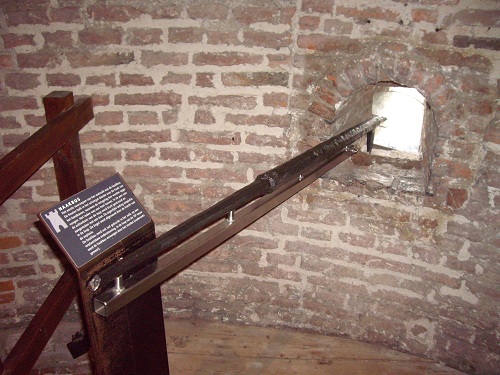
In the above shot you can see another view of the four-barreled handgonne; a large handgonne just below it still being used in Burma in the 19th century; a leather cannon from Manipur, India, below that; and than a typical "hackbut" type of handgonne below that. The hackbut was especially popular in the Low Countries and came with a hook for bracing against a wall, mantlet, or other object. The other objects are later.
And here you have a medieval hand grenade! This one is Byzantine and used their most famous weapon--Greek Fire. The recipe for Greek Fire is lost but it seems to have been a sort of early napalm. This ceramic jar was filled with Greek Fire and had a lit slow match as a fuse. too bad I didn't have this shot when I wrote my history of the Byzantine Empire! Other grenades survive from the Middle Ages too, and contained gunpowder.
The Pitt-Rivers is my favorite museum. It is literally stuffed with items from every culture in the world and every period in history, organized not by time and place but by use. In the photo above you can see an early attempt at a "revolver", a four-barreled handgonne! As I mentioned in my previous guest post on medieval firearms, a handgonne was the earliest form of black powder gun, being lit by a burning cord called a slow match instead of any sort of trigger mechanism. They appeared in the 14th century.
It was an age of experimentation in many technologies and firearms were no exception. Several multi-barreled handgonnes survive and they were obviously an attempt to compensate for the handgonne's slow reloading speed. They are a small minority of all handgonnes, though, so apparently they were considered too unwieldy. Perhaps the lack of a single, straight barrel reduced the already poor accuracy.
In the above shot you can see another view of the four-barreled handgonne; a large handgonne just below it still being used in Burma in the 19th century; a leather cannon from Manipur, India, below that; and than a typical "hackbut" type of handgonne below that. The hackbut was especially popular in the Low Countries and came with a hook for bracing against a wall, mantlet, or other object. The other objects are later.
And here you have a medieval hand grenade! This one is Byzantine and used their most famous weapon--Greek Fire. The recipe for Greek Fire is lost but it seems to have been a sort of early napalm. This ceramic jar was filled with Greek Fire and had a lit slow match as a fuse. too bad I didn't have this shot when I wrote my history of the Byzantine Empire! Other grenades survive from the Middle Ages too, and contained gunpowder.
May 2, 2011
Medieval handgonnes: how accurate were they?
Today I'm happy to host a very special guest blogger, Sean McLachlan, who has not only authored eight books, but also has a blog about his writing life called Mid-list Writer. His latest book is about the world's first rifles. While he does today's Medieval Mondays feature over here, I'm writing about leather armour at his blog. Take it away Sean!
We often hear that medieval guns were crude, inaccurate, and generally ineffective. One common mantra is that they were more dangerous to the wielder than the target. Yet one has to ask, why did armies across Europe incorporate them into their arsenals starting in the 14th century and keep using them until they eventually replaced the longbow and crossbow? Obviously early firearms had something to offer. But what?
When I started researching my book Medieval Handgonnes: The First Black Powder Infantry Weapons, I was shocked that there was no other book written in English on the development of the gun before the matchlock. I found no books in any other language either. Guns are, after all, one of the most important inventions to come out of the Middle Ages. Until very recently historians just accepted the image of crude early handgonnes without testing it or even really thinking about it. While this made my research extra difficult, it also made it extra rewarding.
When I say "handgonne" I mean a handheld black powder weapon fired with a match or hot wire. There was no trigger, no automatic firing. Pretty primitive stuff! "Handgonne" was only one of many terms used in that era.
In recent years reenactors and archaeologists have experimented with medieval recipes for gunpowder and tested replicas handgonnes. They've found these weapons could punch through armor better than a longbow or crossbow, although they have a much shorter effective range. Scholars have long debated how effective a longbow arrow is against plate armor. Many believe arrows had more of a harassing effect, with lucky shots getting into eyeslits, joints, or hitting horses. The escape velocity of the bullet was higher, making it more effective, but since it wasn't as aerodynamic as an arrow it lost velocity pretty quickly. Accuracy was better than people assume. Skilled reenactors can hit a man-sized target most of the time even at 45 meters (49 yards). Since men generally fought in large, compact masses, this made them even easier to hit.
Of course longbows and crossbows had better range, speed, and accuracy. In medieval illustrations you often see bowmen and gonners standing together. This capitalized on the advantages of both weapons while negating the disadvantages. As the enemy advanced they were harassed by the bowmen and when they got in close got cut down by the gonners.
Handgonnes truly came into their own in the 15th century, as improvements in gunpowder production made them more powerful and cheaper. Soon the ratio of guns to bows tilted in favor of the gun. While crossbows and the English longbow lasted on the battlefield for some time, the development of the matchlock in the late 15th century heralded a new era in warfare.
We often hear that medieval guns were crude, inaccurate, and generally ineffective. One common mantra is that they were more dangerous to the wielder than the target. Yet one has to ask, why did armies across Europe incorporate them into their arsenals starting in the 14th century and keep using them until they eventually replaced the longbow and crossbow? Obviously early firearms had something to offer. But what?
When I started researching my book Medieval Handgonnes: The First Black Powder Infantry Weapons, I was shocked that there was no other book written in English on the development of the gun before the matchlock. I found no books in any other language either. Guns are, after all, one of the most important inventions to come out of the Middle Ages. Until very recently historians just accepted the image of crude early handgonnes without testing it or even really thinking about it. While this made my research extra difficult, it also made it extra rewarding.
![]() |
| Western Europe, 1390-1400. Courtesy PHGCOM |
When I say "handgonne" I mean a handheld black powder weapon fired with a match or hot wire. There was no trigger, no automatic firing. Pretty primitive stuff! "Handgonne" was only one of many terms used in that era.
In recent years reenactors and archaeologists have experimented with medieval recipes for gunpowder and tested replicas handgonnes. They've found these weapons could punch through armor better than a longbow or crossbow, although they have a much shorter effective range. Scholars have long debated how effective a longbow arrow is against plate armor. Many believe arrows had more of a harassing effect, with lucky shots getting into eyeslits, joints, or hitting horses. The escape velocity of the bullet was higher, making it more effective, but since it wasn't as aerodynamic as an arrow it lost velocity pretty quickly. Accuracy was better than people assume. Skilled reenactors can hit a man-sized target most of the time even at 45 meters (49 yards). Since men generally fought in large, compact masses, this made them even easier to hit.
| This 15th century hackbut ("hooked gun") braces against a loophole and crossbeam at Muider Castle, The Netherlands. Photo by Sean McLachlan |
Of course longbows and crossbows had better range, speed, and accuracy. In medieval illustrations you often see bowmen and gonners standing together. This capitalized on the advantages of both weapons while negating the disadvantages. As the enemy advanced they were harassed by the bowmen and when they got in close got cut down by the gonners.
Handgonnes truly came into their own in the 15th century, as improvements in gunpowder production made them more powerful and cheaper. Soon the ratio of guns to bows tilted in favor of the gun. While crossbows and the English longbow lasted on the battlefield for some time, the development of the matchlock in the late 15th century heralded a new era in warfare.
Apr 18, 2011
The peasants are revolting. No, really, they are!
Peasants tend to be overlooked by writers and fans of medieval history. They're generally fobbed off as dirty, uneducated, miserable victims of the nobility. Yet at times the peasants struck back. Starting in the 14th century there was a wave of peasant rebellions across Europe. Partly this was due to the effects of the Black Death in the middle of the century. This plague killed about a third of the population, leading to a labor shortage that helped the peasants ask for higher wages, fewer duties, and even more freedom. The nobility pushed back, enacting laws that tried to limit the peasants' gains.
While this was the broad background of the struggle, there was always a specific spark that set off a rebellion in a certain place. During the Hundred Years War in France, the peasants were robbed and abused by both sides and were unimpressed when the French knights were defeated at Poitiers. When these same knights commanded the peasants to protect their stately homes, the peasants rose up in revolt in 1358. The revolt was crushed, as you can see in the picture above courtesy of Wikipedia, but more revolts happened in 1382-5 in response to increased taxes to pay for the war effort.
England had one of the most serious revolts in 1381, in which the rebels took the Tower of London and almost the capital itself. This was in response to a new poll tax and a lack of confidence in the regency government for the boy-king Richard II. Germany was especially prone to revolt. At this time it was a patchwork of different states and the lack of a strong central ruler and army may have encouraged the peasants. There were more than 60 rebellions between 1336 and 1526. The biggest was the German Peasants' War of 1524-6, in which an estimated 300,000 peasants took up arms against their rulers.
In general the peasant rebellions were quickly crushed. Peasant armies lacked the weapons, armor, and training to take on trained soldiers and knights. A major exception was the Hussite Wars of 1419-36. When Bohemian religious reformer Jan Hus was assassinated at what was supposed to be a peaceful religious debate, his followers rose up against what they saw as a corrupt church and German aristocracy.The Hussites, as they called themselves, actually fought off the local nobles and the Holy Roman Empire by the clever strategy of constructing "war wagons"--armored wagons that functioned as mobile fortresses that could stop a charge of knights.
While these were truly "peasants rebellions", other people joined in too. Impoverished townspeople, merchants, and even a few sympathetic (or opportunistic) aristocrats supported many of the rebellions. These episodes make for fascinating reading and can create an interesting backdrop for wargames, RPGs, or fiction.
So don't abuse that peasant too much, mi'lord, otherwise he might use his sickle as a can opener and see what's inside all that armor!
While this was the broad background of the struggle, there was always a specific spark that set off a rebellion in a certain place. During the Hundred Years War in France, the peasants were robbed and abused by both sides and were unimpressed when the French knights were defeated at Poitiers. When these same knights commanded the peasants to protect their stately homes, the peasants rose up in revolt in 1358. The revolt was crushed, as you can see in the picture above courtesy of Wikipedia, but more revolts happened in 1382-5 in response to increased taxes to pay for the war effort.
England had one of the most serious revolts in 1381, in which the rebels took the Tower of London and almost the capital itself. This was in response to a new poll tax and a lack of confidence in the regency government for the boy-king Richard II. Germany was especially prone to revolt. At this time it was a patchwork of different states and the lack of a strong central ruler and army may have encouraged the peasants. There were more than 60 rebellions between 1336 and 1526. The biggest was the German Peasants' War of 1524-6, in which an estimated 300,000 peasants took up arms against their rulers.
In general the peasant rebellions were quickly crushed. Peasant armies lacked the weapons, armor, and training to take on trained soldiers and knights. A major exception was the Hussite Wars of 1419-36. When Bohemian religious reformer Jan Hus was assassinated at what was supposed to be a peaceful religious debate, his followers rose up against what they saw as a corrupt church and German aristocracy.The Hussites, as they called themselves, actually fought off the local nobles and the Holy Roman Empire by the clever strategy of constructing "war wagons"--armored wagons that functioned as mobile fortresses that could stop a charge of knights.
While these were truly "peasants rebellions", other people joined in too. Impoverished townspeople, merchants, and even a few sympathetic (or opportunistic) aristocrats supported many of the rebellions. These episodes make for fascinating reading and can create an interesting backdrop for wargames, RPGs, or fiction.
So don't abuse that peasant too much, mi'lord, otherwise he might use his sickle as a can opener and see what's inside all that armor!
Subscribe to:
Comments (Atom)