Fantasy, mystery, thrillers, horror, historical. . .I write it all, and review it too!
Showing posts with label siege warfare. Show all posts

Sep 18, 2012

Irish castle for sale: a bit of a fixer-upper but a bargain at €75,000

If you're like me, you've always dreamed of living in your own castle. Well, if you happen to have €75,000 ($97,850) you can! It's called Ballyfinboy Castle and it's an easy commute from Limerick, Ireland.

The castle was built around 1480. The first record of the castle was when it was captured in 1599. The owner, Phillip Kennedy, and men were all put to the sword and the castle was broken up enough that it could never be used again.

That's where YOU come in. Sure, it needs some work, but wouldn't it make a nice home? You even get two-and-a-half acres of land and a nice Sheela-na-gig, locally known as "the Dancer", positioned high up one of the walls. Hit the link to find out more about these interesting carvings. The castle is for sale from Premier Properties Ireland. You can see more photos on their website and also here.

Jun 4, 2012

Medieval Mondays: Chinese repeating crossbow

While we tend to think of automatic weapons as a product of the nineteenth century, the Chinese had developed a multi-shot crossbow as early as the fourth century BC. This crossbow had a magazine that could hold up to ten bolts.

The mechanism was brilliant in its simplicity. A single lever pulled back the string while a bolt from the magazine dropped into place. Once fired, the lever simply had to be pulled back again to drop another bolt into place. A more detailed description of its construction can be read here.

The repeating crossbow was held at the hip or on a stand and was generally used to defend fortified areas. A second person could stand to the side feeding bolts into the magazine, allowing the crossbowman to fire continuously at a rate of about a shot every second to a range of perhaps 80 yards. Accuracy would have been poor since it wasn't fired from the shoulder like other crossbows, and it was somewhat weaker than regular crossbows. Still, a few dozen of these on a rampart firing at a mass of charging enemy soldiers must have had an incredible effect.

Such a useful weapon had a long life. They saw service as late as the 1894-1895 war with Japan. By then, however, their worth was somewhat limited. The Japanese had modern repeating rifles that were far deadlier at a longer range. The Japanese won that war.

Photo courtesy Wikipedia.

Feb 14, 2012

Medieval Mondays: the Hexamilion wall

The Hexamilion is the thin black line across the Isthmus
Medieval Mondays is actually on Tuesday this week because yesterday I participated in the Origins blogfest. Thanks to all those who stopped by!

Genre Author follower and occasional guest blogger Sean McLachlan has been traveling in Greece lately for his travel blog Gadling and writing a series of posts. Some of them are of interest to fans of the Middle Ages, such as the castle of Acrocorinth, the Athens War Museum, and the Byzantine ghost town of Mistra. His writing about medieval Greece gave me today's subject--the Hexamilion Wall.

As you can tell from the name, this was a six-mile long defensive wall. It stretched across the Isthmus of Corinth, the only land route into the Peloponnese, the southwestern part of Greece. This obviously strategic point had been fortified since ancient times, and a major wall was erected during the fifth century AD when Germanic tribes were terrorizing the Roman Empire. It was strenghtened in the seventh century and then gradually allowed to decline.

The Hexamilion became important again in the waning years of the Byzantine Empire. The Ottoman Turks were closing in and the Byzantines were anxious to protect the Peloponnese (hten called the Morea) because it was the only wealthy province left to them. In 1415, Emperor Manuel II Palaeologos had it repaired and improved into an impressive fortification with thick walls and numerous towers. This didn't stop the Turks, though, who smashed through it in 1423. It appears there was little fighting; the garrison was so outnumbered and demoralized that most of them ran. The Haxamilion was repaired, but breached again in 1431. Both attacks were raids and the Ottomans did not remain in the Morea.

Constantine Palaeologos, then Despot of Morea and destined to be the last Byzantine Emperor, repaired the wall, but to no avail. In 1446, the Turks came back, this time with a large amount of artillery. Constantine had garrisoned the wall with 20,000 men, but many were Albanian mercenaries who could not be relied upon. After two weeks of bombardment, the Turks stormed the walls and cut down the defenders. Constantine survived, but his wall and his army were destroyed. Sultan Murad signed a treaty with the Byzantines stipulating that the wall would not be repaired.

Not much left!
When Murad died and the warlike Mehmet took the Ottoman throne, the Byzantines repaired the wall anyway. Mehmet's armies easily passed through in 1452. A year later the Byzantine capital Constantinople fell and the Emperor Constantine was killed in action. The Morea held out until 1460, but now the Hexamilion was in ruins and failed to even slow the Turks down.

The Hexamilion was a great idea that didn't work. The Byzantines could never garrison it with sufficient numbers of quality troops to face down the large and disciplined Ottoman army. Little remains of it today. For more on the Hexamilion, check out this cool website about the excavations being carried out there by Ohio State University.


Both images courtesy Wikipedia.

Feb 6, 2012

Medieval Mondays: Reconstructions of Motte-and-Bailey castles

I've always been fond of motte-and-bailey castles. Perhaps that's because I've always been fascinated with the origins of things, like the world's oldest condom. Familiar to any student of the Middle Ages, these rough and ready fortifications provided a cheap and quick way to defend your territory.

For those who aren't as obsessed with castles as I am, a motte-and-bailey castle is an artificial mound (motte) with a keep and wall on top, and a lower enclosed area (bailey) surrounded by a wall. Both parts are surrounded by a ditch, the soil of which was used to make the Motte. An artist's rendering of one can been seen in the above photo courtesy Duncan Grey.

These castles had the advantage of being able to be built by unskilled labor in a matter of months or even weeks, as opposed to stone castles that required highly skilled artisans working for years. The most famous are those of the Normans, who needed lots of quick castles as they expanded through the British Isles.
Trolling through the Interwebs the other day I discovered that in at least two places there are reconstructions of motte-and-bailey castles. The one pictured above is Saint Sylvain d'Anjou dans le Maine et Loire, France. The photo is courtesy Wikipedia. The bottom one is from Turmhügelburg in Nienthal von Lütjenburg, northern Germany, and is also courtesy Wikipedia.
As you can see, neither has a very high motte. This was common, although we tend to think of them having very tall mottes, perhaps because the taller examples have survived better and were often maintained and had stone keeps built atop them at later periods. Windsor castle in England is the most famous example.

While they don't look like much, you must remember that the heyday for these castles was the late 10th through early 12th centuries AD. Siege technology was at a low ebb in Northern Europe, armies were small, and feudal levies wouldn't hang around long enough to commit to an extended siege. Thus the humble motte-and-bailey castle was a formidable defense.

Jan 10, 2012

Medieval Mondays: The Black Gate

Many fantasy fans know and love Black Gate Magazine. They publish heroic fantasy as opposed to the grittier fantasy I did for Roots Run Deep, but I love a good bit of heroism too.

There's also a real Black Gate, which you can see at Newcastle-upon-Tyne. It was added as a barbican to the older Newcastle Castle between 1247 and 1250. A barbican is an outer defense to the gate, providing crossfire for the archers and extra gates for the besieging army to crash through. Often when they did so they came under murder holes from which all sorts of nasties came down on them. I've blogged about this a bit before in my post on the myth of boiling oil.

Newcastle Castle was, like so many others in England, built upon an earlier Norman motte-and-bailey castle, which itself was built upon a Roman fort. Strategic positions don't change much over the years, only the ways of holding them.

The Black Gate has gone through some changes--like the later windows and roof--but it's still one of the best preserved parts of the castle. Actually only the keep, shown below, and some bits of wall are left. Now the Black Gate houses the offices and meeting rooms of the local Society of Antiquaries. I'd love to go to a meeting there!

Top picture courtesy Wikipedia. Bottom photo courtesy Hans Peter Schaefer.

May 30, 2011

Medieval Mondays: Gallery of Crusader Castles

As the final stop on my virtual book tour, I'm over at the Double Dragon Publishing blog talking about the Order of St. Lazarus, a group of leper Crusaders. I figured I'd give you a gallery of Crusader castles this week.

The Europeans learned much of their castle building during the Crusades. The Arabs were much more advanced in defensive architecture but the Crusaders proved to be quick learners. The photo above is of Marqab castle in Syria, courtesy of Shayno. That promontory it's set on is actually an extinct volcano, and makes for a natural defense. The walls aren't too shabby either! Even Saladin wasn't able to take it.
This chunky example is from Byblos in Lebanon, photo courtesy Heretiq. Saladin took this one in the same year, 1188, that he failed to take Marqab castle.
  I love this old photo of Tebnine Castle in Lebanon. Note the rounded corner and digital readout on the lower right corner. T. Dakroub took this shot who-knows-when and really captures the atmosphere. Yes, it snows in the highlands of the Middle East!
Another well located castle is Montfort in Israel, as this shot by Bukvoed shows.The name in French means "strong mountain."
And how could I skip Krak des Chevaliers in Syria, the biggest and best preserved Crusader castle of them all! I've visited this castle myself but none of my photos capture it as well as Ed Brambley did. Like Marqab castle, Krak des Chevaliers was originally an Arab castle taken and expanded by the Crusaders. It served as the headquarters of the Knights Hospitaller.

May 2, 2011

Medieval handgonnes: how accurate were they?

Today I'm happy to host a very special guest blogger, Sean McLachlan, who has not only authored eight books, but also has a blog about his writing life called Mid-list Writer. His latest book is about the world's first rifles. While he does today's Medieval Mondays feature over here, I'm writing about leather armour at his blog. Take it away Sean!

We often hear that medieval guns were crude, inaccurate, and generally ineffective. One common mantra is that they were more dangerous to the wielder than the target. Yet one has to ask, why did armies across Europe incorporate them into their arsenals starting in the 14th century and keep using them until they eventually replaced the longbow and crossbow? Obviously early firearms had something to offer. But what?

When I started researching my book Medieval Handgonnes: The First Black Powder Infantry Weapons, I was shocked that there was no other book written in English on the development of the gun before the matchlock. I found no books in any other language either. Guns are, after all, one of the most important inventions to come out of the Middle Ages. Until very recently historians just accepted the image of crude early handgonnes without testing it or even really thinking about it. While this made my research extra difficult, it also made it extra rewarding.

Western Europe, 1390-1400. Courtesy PHGCOM

 When I say "handgonne" I mean a handheld black powder weapon fired with a match or hot wire. There was no trigger, no automatic firing. Pretty primitive stuff! "Handgonne" was only one of many terms used in that era.

In recent years reenactors and archaeologists have experimented with medieval recipes for gunpowder and tested replicas handgonnes. They've found these weapons could punch through armor better than a longbow or crossbow, although they have a much shorter effective range. Scholars have long debated how effective a longbow arrow is against plate armor. Many believe arrows had more of a harassing effect, with lucky shots getting into eyeslits, joints, or hitting horses. The escape velocity of the bullet was higher, making it more effective, but since it wasn't as aerodynamic as an arrow it lost velocity pretty quickly. Accuracy was better than people assume. Skilled reenactors can hit a man-sized target most of the time even at 45 meters (49 yards). Since men generally fought in large, compact masses, this made them even easier to hit.

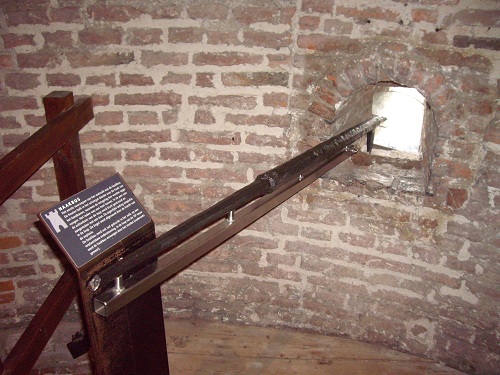
This 15th century hackbut ("hooked gun") braces against a loophole and crossbeam at Muider Castle, The Netherlands. Photo by Sean McLachlan


Of course longbows and crossbows had better range, speed, and accuracy. In medieval illustrations you often see bowmen and gonners standing together. This capitalized on the advantages of both weapons while negating the disadvantages. As the enemy advanced they were harassed by the bowmen and when they got in close got cut down by the gonners. 

Handgonnes truly came into their own in the 15th century, as improvements in gunpowder production made them more powerful and cheaper. Soon the ratio of guns to bows tilted in favor of the gun. While crossbows and the English longbow lasted on the battlefield for some time, the development of the matchlock in the late 15th century heralded a new era in warfare.

Feb 28, 2011

Medieval Mondays: Siege Warfare and the Myth of Boiling Oil

As someone who studies the Middle Ages, common mistakes in writing irk me. One of them is the use of boiling oil in siege warfare. We're told that when people attacked a castle the defenders poured boiling oil down on them.

This hardly ever happened. Oil made from animal flesh, olives, or other materials was labor intensive to produce and expensive, far too expensive to literally throw away. In general, defenders of castles poured boiling water down on attacking troops. Every castle had a plentiful supply of water. It was one of the critical elements when choosing where to build a fortification. There are numerous instances of castles surrendering when their water supply dried up or got contaminated by the besieging forces.

I'm not sure where the myth of boiling oil came from. There's a Roman account of using boiling oil, but in the vast majority of cases the much cheaper and more available water was used. In one case in France, however, some men-at-arms poured molten lead on a knight. That must have seriously hurt!

Boiling liquids of whatever kind were poured out of murder holes like the one seen here courtesy of Wikimedia Commons. These holes opened out onto the outsides of walls of gates, or inside barbicans. Rocks and other nasties could also be thrown down. Medieval warfare wasn't pretty!